Smell-O-Vision Grew Up: The Quiet Race to Put a Nose on Your Headset
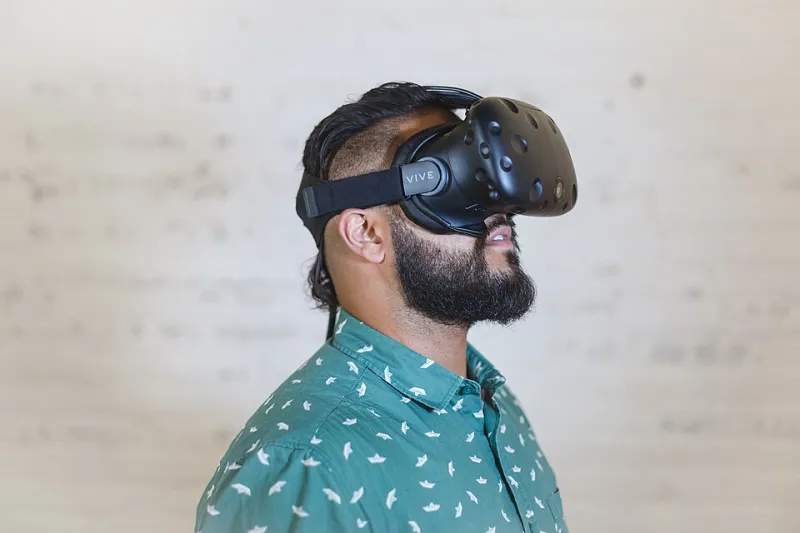
Photo: Matthew Henry, CC0, via Wikimedia Commons
There's a moment in every scent-tech demo where the room goes quiet. Someone slides on a headset, a cartridge clicks into place, and a few seconds later they're describing something they can't see. Cut grass. The inside of a grandmother's garage. Burnt sugar, specifically the bottom of a pan.
Then a fan kicks on, the smell vanishes, and everyone laughs, and the founder says some version of "we're about four years out."
That line has been in circulation since the Eisenhower administration. Smell-O-Vision and AromaRama made theaters smell like whatever the projector said, badly, in the late 1950s and early 1960s. The iSmell peripheral promised a scented internet in 1999 and became a running joke. So it would be reasonable to assume the whole category is a perpetual demo.
Except something shifted. The hardware got small, the cartridges got cheap, and the sensor stack inside a modern headset now knows enough about your breathing and your reaction time to make smell interesting to people who sell things. The race is back on, and this time the interesting part isn't the smell. It's the file that gets built about your nose.
The one sense that refuses to be faked
Vision and audio are physics problems with tidy solutions. You can synthesize a photon; you can push a pressure wave through a driver. Smell is chemistry, and chemistry doesn't render.
Humans carry a few hundred distinct olfactory receptor types, and they fire in combinations, which means the space of possible smells is effectively unbounded. There's no RGB for your nose. To make someone smell something, you have to physically deliver molecules to them, in the right concentration, at the right moment, and then get rid of them before the next scene.
That last part is where most of the engineering lives. Scents linger. They mix with whatever was there before. Your receptors habituate within seconds, so a sustained smell fades even while it's still in the air. A headset can't just play a scent the way it plays a sound. It has to sequence, clear, and reset — which makes digital smell less like audio and more like a very small, very fussy HVAC system.
What's actually shipping
The current generation splits into three camps.
Cartridge mixers. A handful of primary scent compounds, blended on the fly the way a printer blends ink. Six to a few dozen bases gets you a surprisingly wide range, and the pulses are now fast enough to sync with a scene instead of arriving a beat late. The limitation is the same as always: you're approximating, not reproducing.
Haptic and airflow masks. These cheat, in a good way. A puff of cool air, a change in humidity, a hint of a smell at low concentration, and the brain does the rest. It's the olfactory equivalent of a rumble pack — not accurate, but convincing enough to sell presence.
Direct stimulation research. Lab groups have been experimenting with delivering chemical stimuli very close to the olfactory epithelium, and with electrical approaches that are earlier and messier. The realistic near-term market for this isn't games. It's clinical: smell training after anosmia, exposure therapy, diagnostic work. If you want to understand why researchers care, remember that a few years of post-viral smell loss got a lot of people suddenly invested in the science of scent.
The vent is the product
Here's the unglamorous truth: whoever wins this category will win on air handling, not on scent libraries.
Shared headsets in an arcade or a showroom raise questions nobody wants to answer on stage. Cross-contamination. Cleaning protocols. Condensation. Filters that need swapping on a schedule a teenager working the counter will actually follow.
Then there's consent, which in this context is not abstract. Allergies. Asthma. Pregnancy nausea. Migraine triggers. Sensory sensitivities that make surprise smells genuinely distressing rather than playful. A scent interface that can't be quickly and completely turned off is not a product; it's a liability with a USB-C port.
Your scent profile is the payload
Smell sits closer to memory and emotion than any other sense — the wiring runs almost directly from the olfactory bulb into the limbic system, which is why a single whiff can drop you into a specific afternoon in 2004. That's what makes it a compelling medium. It's also what makes it a compelling dataset.
Think about what a scent-capable device can log. Which scenes you replay. How long you linger. Which of forty cartridge mixes you skip, and which ones you lean into. Add the breath and heart-rate sensors that already live in high-end headsets, and you have a signal about emotional response that's harder to fake than a click.
A scent profile is biometric-adjacent data with a marketing department's dream attached to it. And in the US, there is no federal statute that specifically names it. What exists is a patchwork: state biometric laws, health-data laws, general consumer privacy statutes in a subset of states, and whatever a given company's terms of service happen to say at the moment you click agree.
Nose-level consent
If this category is going to be more than a trade-show gag, it needs a few norms established early, while there's still room to establish them.
- Per-session, per-scent opt-in. Not a blanket toggle buried three menus deep.
- Visible inventory. You should be able to see every compound the device can emit, the way you can read an ingredient label.
- A hard off. Physical, obvious, and effective within a second.
- Data separation. Reaction telemetry shouldn't be bundled with the smell library by default.
- Some legal clarity on scent as IP. Scent trademarks exist, but they're narrow and notoriously difficult to enforce. Expect that fight to get louder.
The smell test
The likeliest path isn't a scented living room by Christmas. It's training simulations where smell adds real information, food and beverage R&D, high-end retail, clinical use, and a handful of location-based experiences where a staffed attendant can manage the cartridges.
Which is fine. Every sense computers learned to handle started as a niche tool with bad latency. We spent thirty years teaching machines to see and hear. Teaching them to smell means teaching them to notice us in a way we can't easily narrate — and that deserves a policy conversation before it deserves a product launch.