The Divide Isn't Being Dug. It's Being Launched.
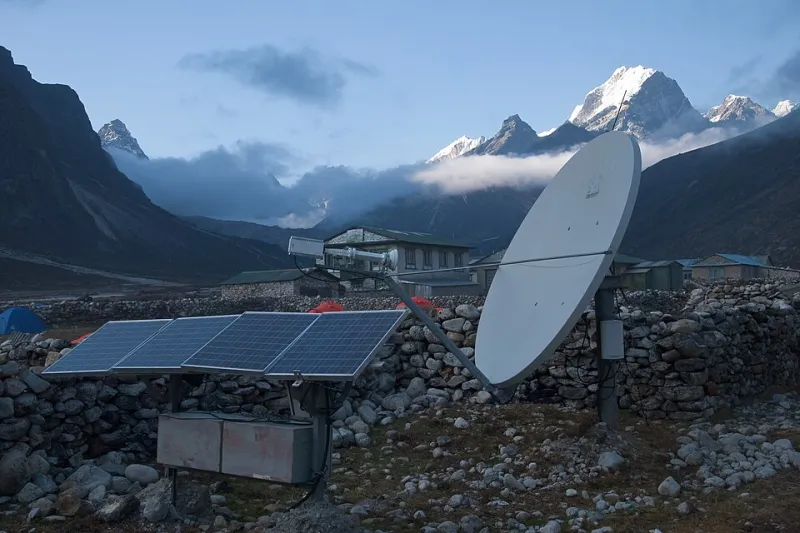
Photo: Vyacheslav Argenberg, CC BY 4.0, via Wikimedia Commons
Let me say the quiet part first: low-orbit satellite internet has accomplished more for rural connectivity in the last four years than federal broadband grants managed in the previous fifteen. I've watched the argument about this play out in comment sections and hearing rooms, and the defenders of the status quo keep reaching for the same rebuttal — it's not that simple. But out where the fiber ends and the DSL crawls, simplicity is exactly what people needed, and a dish on the roof delivered it.
The Trench That Never Got Dug
Rural broadband is America's longest-running infrastructure punchline. Billions in subsidies have flowed through program after program — the e-rate, RDOF, BEAD — and yet the map of who actually has usable internet looks like a map of who happens to live near a co-op that got funded in 2009.
The problem was never the money. It's the math. Running fiber to a rancher forty minutes outside of Lubbock costs a fortune per household, and no carrier's shareholders were going to eat that. So the grants went where the unit economics worked, which is to say, not to the people who needed them. Meanwhile, a kid doing homework in a truck parking lot became the unofficial mascot of the digital divide.
Then the satellites showed up. Thousands of them, flying low, beaming latency that finally made video calls and gaming survivable. No trenching. No easement fights. No waiting for a carrier to decide your county clears the ROI bar. Sign up, mount the dish, done. For households that spent two decades on the wrong side of a coverage map, that's not a product launch. That's a door opening.
Now the Uncomfortable Part
Here's where my enthusiasm hits a wall with a company logo on it.
The same qualities that make satellite internet fast to deploy make it dangerously concentrated. We're not talking about a competitive market with a dozen providers — we're talking about one dominant constellation, owned by one man, whose other business interests include a certain social platform and a certain car company, and whose whims have a documented habit of reshaping geopolitics. Ask the people who watched connectivity get switched on and off in a war zone whether single-provider dependency is a theoretical concern.
A rural America wired to one company's constellation isn't a divide closed. It's a divide relocated — from the ground to the shareholder meeting. When your town's telehealth, farm futures pricing, kids' schooling, and emergency alerts all ride on one billionaire's orbital infrastructure and one government contract's goodwill, that's not resilience. That's a hostage situation with good latency.
What Actually Needs to Happen
The answer isn't to kneecap satellite internet. It's to refuse the false choice between trench and orbit.
Federal money should treat LEO broadband as legitimate infrastructure — but attach the same conditions we'd demand of any utility: interoperability standards, rural buildout obligations for terrestrial backup, and genuine support for competing constellations like Amazon's Kuiper so this becomes a market instead of a monarchy. States should keep pushing fiber to anchor institutions — schools, hospitals, libraries — so communities have a physical backbone even when the sky has a bad day.
The next web might well be beamed from above rather than buried below. Fine. But a nation's information arteries shouldn't have a single point of failure with a personality. We spent thirty years failing to dig our way out of the divide. Let's not launch ourselves into a worse one.