Money That Doesn't Need a Bank: A Beginner's Field Guide to Currencies Built for Chaos
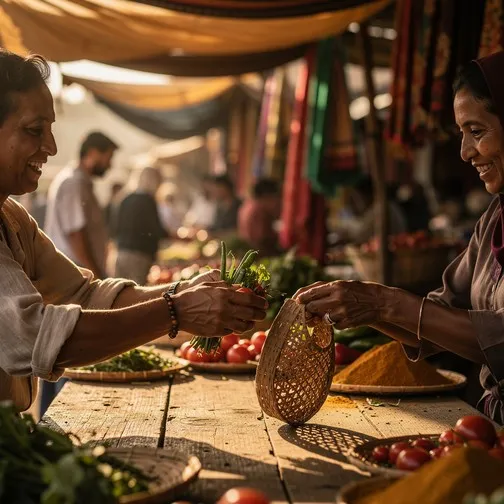
Photo: diverse community members exchanging goods local market digital tokens, via images.stockcake.com
Let's be real: the last few years have made a lot of people quietly nervous about money. Inflation spikes, bank collapses, crypto meltdowns, student debt limbo — the financial system has been throwing fastballs, and a lot of folks are wondering whether there's a backup plan. Turns out, there is. Several, actually. And they've been running in the background for longer than you might think.
This isn't a doomsday piece. It's a field guide. Whether you're a curious early adopter, a community organizer, or just someone who wants to understand what a post-scarcity micro-economy actually looks like in practice, here's where to start.
First: What Do We Even Mean by "Alternative Currency"?
The term sounds fringe, but the concept is ancient. Any system where a community agrees that something has value — and exchanges it accordingly — is a currency. The US dollar works because we all agree it does. So does a time-bank credit, a local business token, or a mutual aid ledger.
What makes the current moment interesting is that digital tools have dramatically lowered the barrier to building and running these systems. What once required a nonprofit infrastructure and a lot of spreadsheets can now be managed through a smartphone app. That shift is enabling a new generation of community-scale economies that are genuinely functional, not just theoretical.
Time Banks: The OG Alternative Economy
What it is: You spend an hour helping someone fix their fence. You earn one time credit. You spend that credit getting someone to tutor your kid in math. Every hour is worth the same, regardless of the task.
Where it's actually happening: Time banking has been around since the 1980s, but US networks have seen renewed growth. hOurworld, one of the largest US time-bank platforms, connects thousands of members across dozens of communities. Detroit, in particular, has become something of a time-banking hub, with neighborhood networks filling gaps left by economic disinvestment.
Why it matters now: Time banks are recession-proof almost by definition. When dollars get tight, time doesn't. They also build the kind of dense community trust that functions as social infrastructure — which turns out to be pretty valuable when other systems get wobbly.
How to get started: Search for a time bank in your area through TimeBanks USA (timebanks.org). If there isn't one nearby, the platform makes it relatively straightforward to start one.
Community Tokens: Hyper-Local Crypto That Actually Has a Point
What it is: A blockchain-based token issued by and for a specific community — a neighborhood, a small town, a network of local businesses — designed to keep economic activity circulating locally rather than bleeding out to Amazon and national chains.
Where it's actually happening: Grassroots Economics, while Kenya-based, has pioneered a model that US communities are beginning to adapt. Closer to home, projects like the Berkshares system in western Massachusetts (technically a paper currency, but increasingly going digital) have demonstrated that regional currency can drive real local economic loyalty. Newer blockchain-based experiments are popping up in places like Colorado and Vermont, where rural communities are testing token systems tied to local goods and services.
Why it matters now: Community tokens create a kind of economic moat around local businesses. When you spend a community token at a local restaurant, that value can only be redeemed locally — it can't leak out to a shareholder in another state. In a period of economic uncertainty, that circulation effect is genuinely stabilizing.
How to get started: Platforms like Celo and Breadchain Cooperative are building infrastructure specifically for community token projects. If you're more of a joiner than a builder, look for local business loyalty networks in your city — many are quietly running proto-token systems already.
Mutual Credit Networks: Money Without the Money
What it is: Imagine a business network where members can trade goods and services without any cash changing hands. You provide $500 worth of web design to another member, and you receive $500 in trade credits you can spend anywhere in the network. No bank required.
Where it's actually happening: The Sardex network in Sardinia is the most famous example globally, but the US has its own version in networks like ITEX and BizXchange, which operate mutual credit exchanges for small businesses across the country. Hundreds of millions of dollars in transactions flow through these systems annually — largely invisible to mainstream financial media.
Why it matters now: For small businesses, mutual credit is essentially a zero-interest line of credit backed by your own productive capacity. During credit crunches or banking disruptions, that's not a small thing.
How to get started: Search for a mutual credit or barter exchange network in your region. IRTA (irta.com) maintains a directory of legitimate trade exchanges operating in the US.
Decentralized Autonomous Organizations (DAOs): The Weird, Promising Frontier
What it is: A collectively owned, blockchain-governed organization where members hold tokens that represent both financial stake and voting power. Think of it as a co-op that runs on smart contracts.
Where it's actually happening: DAOs have had a rough couple of years thanks to the broader crypto winter, but the underlying model is maturing. Gitcoin funds open-source software development through community governance. FWB (Friends With Benefits) operates as a cultural membership DAO with real-world events and economic activity. Nouns DAO funds community projects through daily NFT auctions — and has given away millions to everything from public art installations to open-source tools.
Why it matters now: DAOs are still experimental, but they represent the most radical version of the thesis here: economic coordination without centralized institutions. When those institutions fail or exclude people, DAOs offer an alternative architecture.
How to get started: Honestly? Start by joining one as a member before trying to launch one. The learning curve is real. Bankless DAO and Gitcoin are relatively accessible entry points for curious newcomers.
The Bigger Picture
None of these systems is a perfect replacement for the dollar, and none of them is trying to be. What they are is a hedge — a way of building economic resilience at the community level that doesn't depend on any single institution staying solvent and trustworthy.
Early adopters have always understood that the future doesn't arrive all at once. It shows up first in the margins, in the experiments, in the communities willing to try something different before everyone else catches on. The people running time banks in Detroit and community tokens in Vermont aren't waiting for Washington to fix the financial system. They're building something that works right now, in the world as it actually is.
That's pretty much the whole FutureVerse ethos, right there.